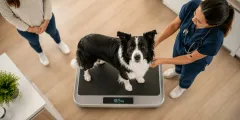






Once your dog has finished growing, weight monitoring doesn’t stop — it just changes its purpose. Instead of tracking development, the goal becomes detecting changes that could point to illness, too many calories or not enough food before they worsen. The key is knowing how often to weigh your dog without obsessing over normal day-to-day variation.
Important: this article is educational and does not replace veterinary advice. If your dog loses or gains weight quickly, or weight changes come with vomiting, diarrhoea, lethargy, increased thirst or appetite changes, contact your vet.
Quick summary
| Dog situation | Weighing frequency | When to call the vet |
|---|---|---|
| Healthy adult, stable weight | Once a month | If the trend changes without a clear reason. |
| Obesity-prone breed | Every 2–3 weeks | If weight keeps rising despite measured food and exercise. |
| Senior dog, around 7 years or older | Every 2–3 weeks | Earlier if there is appetite change, thirst, weakness or muscle loss. |
| Giant breed senior | Every 2–3 weeks, sometimes earlier in life | Ask your vet when senior monitoring should begin. |
| Small breed senior | Every 2–3 weeks, often later in life | Call sooner for even small rapid changes. |
| Weight-loss or recovery plan | Weekly, or as directed | If the loss or gain is faster than the plan. |
| Chronic illness or post-surgery | As directed by your vet | If symptoms worsen or the trend changes suddenly. |
The general rule: once a month for healthy dogs
For many healthy adult dogs, monthly weighing is a practical interval: frequent enough to notice trends, but not so frequent that normal day-to-day variation becomes confusing.
As a rule of thumb, a change of more than 5 % of body weight in one month with no obvious cause (diet change, activity level, season) deserves veterinary attention. Any rapid weight change with symptoms should be checked sooner, even if it is less than 5 %.
If you are not sure what range is healthy for your dog, compare the trend with an ideal weight by breed guide instead of judging a single number in isolation.
How to adjust the frequency
Use the monthly rhythm as a baseline, then increase it when the risk of change is higher:
- Every 2–3 weeks for senior dogs or breeds prone to weight gain.
- Weekly for most weight-loss plans, unless your vet gives a different schedule.
- More often only when your vet asks for it, such as after surgery, during recovery or with chronic disease.
Why senior dogs need more frequent monitoring
From around 7 years (earlier in giant breeds, later in toy breeds), metabolism changes. Older dogs commonly:
- Lose muscle mass even with stable weight.
- Accumulate abdominal fat without a visible overall weight increase.
- Develop chronic conditions (hypothyroidism, kidney disease, diabetes) that directly affect weight.
That’s why senior dogs should be weighed every 2–3 weeks, supplemented by more frequent body condition assessments.
Breeds prone to weight gain
Some breeds have a genetic tendency to gain weight easily. If you have one of these dogs, increase the weighing frequency:
- Labrador Retriever and Golden Retriever: both are commonly prone to weight gain. Some Labrador Retrievers have POMC variants linked to higher food motivation.
- Beagle: Very prone to obesity without dietary control.
- Cocker Spaniel, Basset Hound, Dachshund: Predisposed to overweight.
- Pug, English Bulldog, Boston Terrier: Brachycephalic conformation worsens the consequences of excess weight.
How to weigh an adult dog at home
Small and medium dogs (< 20 kg)
Use a high-capacity kitchen scale or place them directly on a bathroom scale if they are calm enough.
Large and giant dogs
The most practical method is the subtraction method with a bathroom scale: weigh yourself alone, then hold the dog and subtract. Always do it under the same conditions to minimise measurement error.
Tip: Always weigh before the first meal of the day and before the first walk. Variation due to stomach contents or water retention can be up to 500 g in a medium dog.
Warning signs that justify an immediate weigh-in
Don’t wait for the next scheduled weigh-in if you notice:
- Your dog is eating less or much more than usual.
- You can visually see they have gained or lost weight.
- Associated symptoms appear (vomiting, diarrhoea, lethargy, excessive thirst).
- There has been a recent change in medication, diet or activity level.
Make weighing a habit with reminders
The biggest enemy of weight monitoring isn’t an occasional lapse — it’s the absence of a system. A monthly phone reminder, a note on the fridge, or a pet health app eliminates the uncertainty of “when did I last weigh them?”
How Dogtorcito helps with weight tracking
Dogtorcito helps you keep weight records, dates, notes and reminders in one place, so your vet can see the trend instead of relying on one isolated number.
Dogtorcito lets you set weigh-in reminders tailored to your dog’s required frequency and log each measurement with its date and notes. The evolution chart helps you see at a glance whether weight is staying stable or changing over time.
When you arrive at the vet with 6 or 12 months of weight data, the professional can identify patterns that are invisible from a single measurement.
The right weighing frequency isn’t the same for every dog, but one thing is universal: record, don’t just weigh. A number without historical context has little value; a series of data points over time enables sound decisions.
FAQ
How often should I weigh a healthy adult dog?
For many healthy adult dogs, once a month is enough. Use the same scale, similar timing and a simple record so you can compare the trend rather than one isolated number.
Is a 5 % weight change always an emergency?
Not always, but it is a useful warning threshold. A change of more than 5 % in one month without a clear reason should be discussed with your vet, and any fast change with symptoms should be checked sooner.
Should senior dogs be weighed more often?
Yes. Many senior dogs benefit from weighing every 2–3 weeks, especially if they have chronic disease, appetite changes or muscle loss. Senior age usually starts around 7 years, earlier in giant breeds and later in small breeds.
References
- AAHA: 2021 Nutrition and Weight Management Guidelines
- AAHA: Senior Care Guidelines for Dogs and Cats
Related articles: